
AI Overviews are fundamentally changing how digital visibility works.
Instead of ranking ten blue links and letting users choose, AI systems now synthesize information and generate answers. That shift transforms SEO from a ranking discipline into a citation and representation discipline.
When Google’s AI Overviews, ChatGPT, Perplexity, Claude, or Bing Copilot generate answers, they don’t randomly select sources. They rely on layered authority signals that determine which content is trustworthy, structured, and semantically aligned enough to be referenced.
Understanding how AI Overviews choose sources is no longer optional. It is the foundation of modern search visibility.
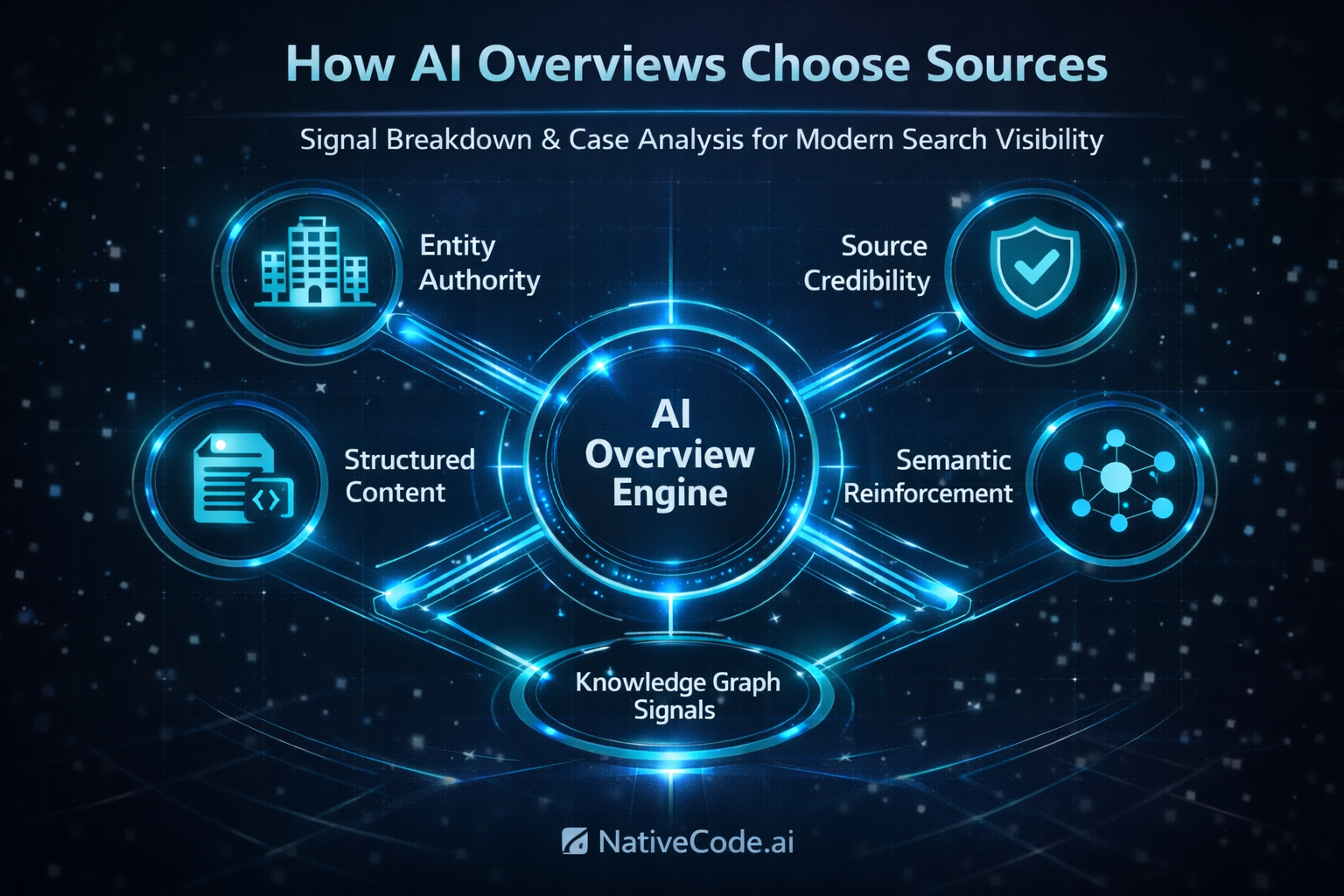
This guide breaks down the five primary signals that influence AI citation behavior:
- Entity authority
- Source credibility
- Structured content
- Semantic reinforcement
- Knowledge graph signals
We’ll also analyze real-world case patterns to understand why some brands consistently appear in AI answers while others remain invisible.
The Shift from Ranking to Representation
Traditional SEO was primarily about ranking signals: links, keywords, on-page optimization, and user engagement.
AI-driven systems operate differently.
They are retrieval-and-synthesis engines. Instead of presenting documents, they extract information from multiple sources and construct responses.
This changes the visibility equation.
Success is no longer defined by position one. It is defined by whether your brand becomes part of the answer.
To understand how that happens, we must examine the signals AI systems use to select sources.
1. Entity Authority
What Is Entity Authority?
Entity authority refers to how strongly a brand, organization, or person is defined and recognized within a topic ecosystem.
In traditional SEO, pages ranked. In AI search, entities are evaluated.
An entity can be:
- A brand
- A company
- A product
- A person
- A concept
AI systems do not simply evaluate keywords on a page. They evaluate whether your brand is an established authority within a defined knowledge domain.
How AI Systems Detect Entity Authority
Large language models and AI retrieval systems rely on:
- Repeated co-occurrence with a topic
- Contextual authority signals
- Structured entity references
- External validation
- Cross-platform presence
For example:
If a brand is consistently mentioned alongside “AI search optimization,” appears in industry publications, and publishes deep technical resources on the topic, AI models begin associating that brand as an authority entity within that subject cluster.
Over time, that brand becomes statistically “safe” to cite.
Entity Authority vs Keyword Optimization
Keyword optimization focuses on matching query language.
Entity authority focuses on topic ownership.
If multiple sources discuss “AI discovery strategy,” but only one brand repeatedly publishes research, frameworks, diagrams, and case studies on it, AI systems are more likely to attribute synthesized insights to that brand.
This is why some companies dominate AI Overviews even without ranking #1 organically.
They have entity gravity.
Case Pattern: Recognized Industry Entities
When AI Overviews generate responses about digital marketing trends, certain brands repeatedly surface:
- Major research platforms
- Long-standing SaaS tools
- Established analytics providers
These entities appear because they are structurally embedded within the topic graph.
They are not just optimized pages.
They are recognized knowledge nodes.
Building Entity Authority Strategically
To strengthen entity authority:
- Publish original frameworks (not just summaries)
- Maintain consistent topical depth
- Build structured author profiles
- Connect your brand to defined concepts
- Ensure cross-platform reinforcement (LinkedIn, podcasts, industry mentions)
Entity authority compounds. It cannot be gamed quickly.
AI systems reward consistency over time.
2. Source Credibility
The Trust Layer
Entity authority determines topic ownership.
Source credibility determines trustworthiness.
AI systems must reduce hallucinations. To do this, they weight content from sources deemed reliable.
Credibility signals include:
- Domain age
- Publication history
- Editorial standards
- External citations
- Brand reputation
- Institutional affiliation
What Makes a Source “Safe” to Cite?
AI retrieval systems prioritize sources that demonstrate:
- Fact-based writing
- Clear authorship
- Transparent methodology
- Updated information
- Consistent publishing cadence
Websites that contain excessive affiliate bias, aggressive monetization overlays, or thin content are less likely to be cited in AI Overviews.
The goal of AI systems is to reduce risk.
Credible sources reduce risk.
Domain Reputation as a Statistical Trust Indicator
Large language models are trained on broad web corpora. During training, they learn patterns about which domains consistently provide accurate, structured information.
If a domain has historically been associated with authoritative information, AI systems are more likely to retrieve and cite it.
Conversely, domains associated with misinformation patterns may be deprioritized.
This is not manual punishment. It is statistical weighting.
Case Pattern: Why Major Publications Dominate
When users ask AI systems about:
- Economic trends
- Health recommendations
- Industry research
The answers frequently cite well-known publications.
These organizations have:
- Institutional authority
- Editorial processes
- Long-term domain credibility
- Structured reporting standards
AI systems lean on them because they represent low-risk knowledge anchors.
Strategic Credibility Signals for Emerging Brands
Smaller brands can compete if they:
- Cite primary data sources
- Publish transparent methodologies
- Include author bios with expertise
- Maintain consistent update cycles
- Earn high-quality editorial backlinks
Credibility is cumulative.
Each citation strengthens future citation probability.
3. Structured Content
Why Structure Matters to AI Systems
AI retrieval systems must extract usable information.
Unstructured content creates ambiguity.
Structured content provides clarity.
AI-friendly content typically includes:
- Clear H2/H3 hierarchies
- Bullet lists
- Definitions
- Tables
- FAQ blocks
- Schema markup
- Summaries
- Step-by-step frameworks
Structured writing reduces interpretation friction.
How AI Parses Structured Pages
When an AI system scans a page, it looks for:
- Topic clarity in headings
- Section-level independence
- Defined answer blocks
- Concise summaries
- Semantic grouping
Pages that bury insights within long paragraphs are harder to extract from.
Pages that clearly define sections are easier to cite.
Featured Snippets as a Precursor
Before AI Overviews, Google used featured snippets.
Those snippets were drawn from:
- Direct answer paragraphs
- Structured definitions
- List-based breakdowns
AI Overviews evolved from that extraction logic.
If your content wins featured snippets, it likely has the structural clarity needed for AI citation.
Case Pattern: Structured FAQs and AI Citations
Pages with structured FAQ sections are frequently cited in AI answers because:
- They contain concise answers
- They align with natural language queries
- They are formatted for extraction
Adding FAQPage schema increases machine-readability.
That improves retrieval precision.
Advanced Structural Enhancements
To maximize citation potential:
- Use definitional subheadings
- Provide short summary paragraphs after each section
- Include scannable frameworks
- Add entity-rich anchor text internally
- Implement structured data markup (Organization, Article, FAQ)
Structure is not cosmetic.
It is computationally strategic.
4. Semantic Reinforcement
Beyond Keywords: Contextual Depth
AI systems operate on semantic relationships.
They evaluate how deeply a page covers related concepts.
For example:
If a page discusses “AI search optimization” but never mentions:
- Knowledge graphs
- Entity modeling
- Structured data
- Retrieval systems
- LLM training
It appears shallow.
Semantic reinforcement means covering adjacent concepts naturally and coherently.
Topical Completeness
AI retrieval systems prefer comprehensive coverage.
If multiple documents answer a question, the one with broader contextual alignment often wins citation priority.
This is because it reduces the risk of partial interpretation.
How Semantic Networks Influence Retrieval
Large language models represent words as vectors within high-dimensional space.
Concepts that frequently co-occur become linked.
If your content consistently integrates semantically connected terminology, it strengthens contextual authority.
This increases citation probability.
Case Pattern: Why Comprehensive Guides Win
Long-form, detailed resources often outperform shorter posts in AI citations because:
- They answer multiple related sub-questions
- They provide definitional clarity
- They reduce ambiguity
- They offer reinforcement across semantic clusters
Shallow content struggles in AI-driven ecosystems.
Implementing Semantic Reinforcement
To strengthen semantic depth:
- Identify topic clusters, not just keywords
- Include definitional context
- Reference industry terminology
- Answer adjacent questions
- Link internally to related deep resources
The goal is to signal that your page exists within a fully developed knowledge network.
5. Knowledge Graph Signals
The Structural Backbone of AI Overviews
Knowledge graphs are structured representations of entities and their relationships.
Google’s Knowledge Graph, Microsoft’s graph systems, and other entity-based databases help AI systems understand:
- What something is
- How it connects to other concepts
- Whether it is verified
Knowledge graph inclusion increases citation likelihood dramatically.
How Brands Connect to Knowledge Graphs
Signals that influence graph association:
- Organization schema markup
- Wikipedia references
- Wikidata entries
- Consistent NAP data
- Structured profiles
- Authoritative mentions
When your brand becomes a defined entity node in a knowledge graph, AI systems can confidently associate your content with specific topics.
Entity Relationships and Topical Authority
Knowledge graphs map relationships:
- Company → Industry
- Person → Expertise
- Product → Category
- Brand → Innovation
If your brand is repeatedly associated with a defined topic category, it becomes a high-confidence retrieval source.
Case Pattern: Recognized SaaS Platforms
Established software companies often appear in AI answers because they are deeply embedded in knowledge graphs.
They have:
- Structured data
- Public documentation
- Cross-domain citations
- Institutional references
This creates graph-level reinforcement.
Strengthening Knowledge Graph Presence
Practical strategies:
- Implement comprehensive schema
- Create consistent About pages
- Maintain verified social profiles
- Earn authoritative citations
- Publish original research tied to your entity
Graph visibility amplifies citation consistency.
Case Analysis: Why Some Brands Appear in AI Overviews Repeatedly
Across industries, patterns emerge.
Brands that dominate AI citations typically:
- Own a defined entity identity
- Maintain high credibility signals
- Publish structured, extractable content
- Cover topics comprehensively
- Connect strongly within knowledge graphs
Visibility is not accidental.
It is structural.
The Compounding Effect of AI Citations
When a brand is cited in AI Overviews:
- Its visibility increases
- Its authority perception strengthens
- Its future citation probability rises
- Its trust weighting improves
This creates a feedback loop.
Representation compounds.
The Strategic Implication for Modern SEO
Optimizing for AI Overviews requires:
- Entity-first content architecture
- Structured publishing discipline
- Trust reinforcement
- Semantic depth
- Knowledge graph integration
Traditional SEO tactics alone are insufficient.
The goal is not just ranking.
The goal is becoming part of the answer.
Final Insight
AI Overviews choose sources based on layered signal confidence.
They do not reward shortcuts.
They reward structure, credibility, and semantic authority.
Organizations that align content architecture with these signals will not only rank — they will be cited.
And in the era of AI-generated answers, citation is the new visibility.
Insights from the Field
Practical guidance on SEO, AEO, and scalable growth — based on real systems, not theory.