
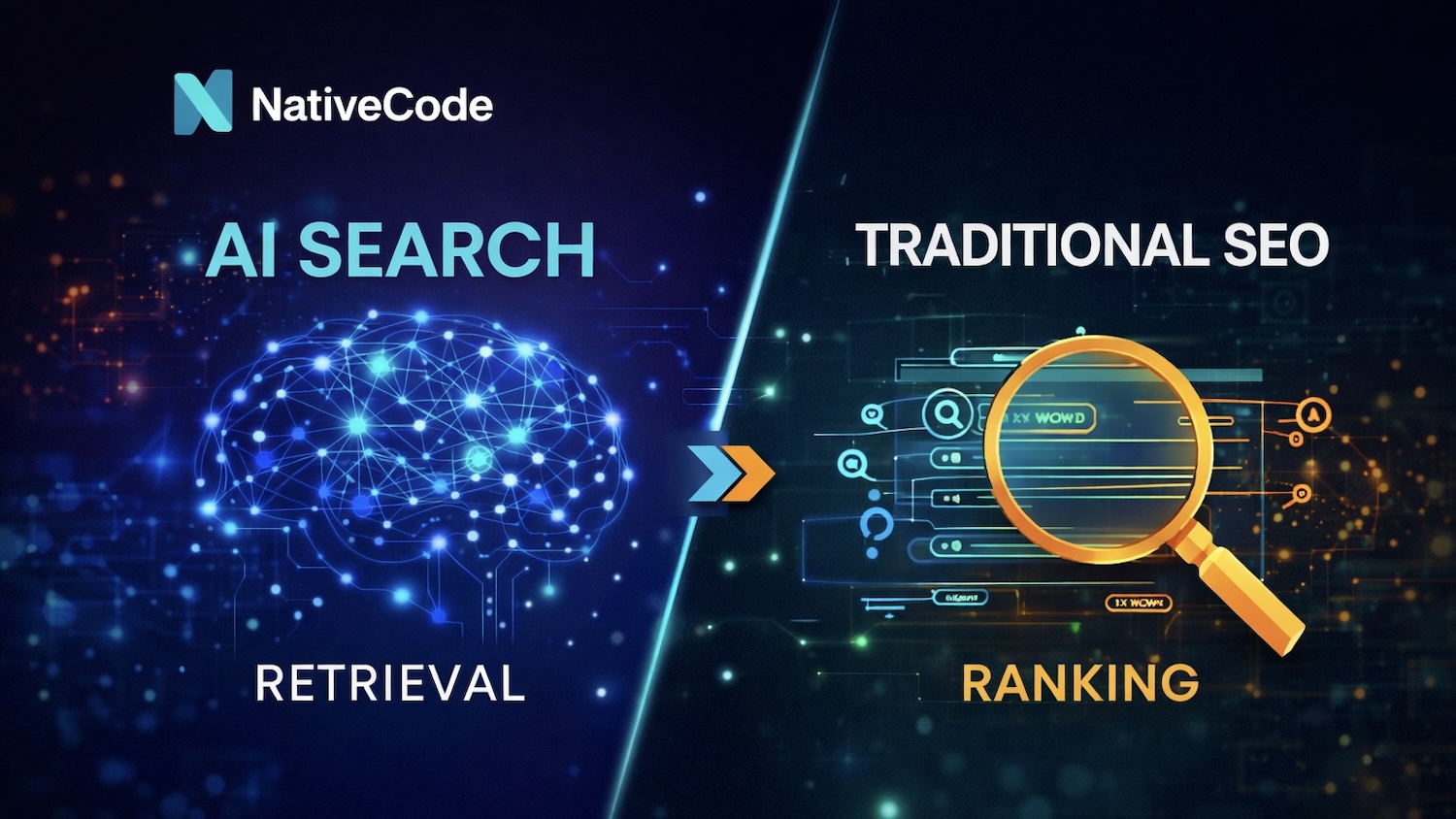
Search visibility is undergoing the most important transformation since Google introduced PageRank.
For more than two decades, traditional search engine optimization (SEO) operated under a relatively stable framework. Brands optimized web pages, acquired backlinks, improved rankings, and measured success through clicks and traffic growth. That model rewarded tactical precision—keyword placement, technical structure, and link acquisition.
But AI-powered search systems are redefining how information is surfaced.
Platforms such as Google AI Overviews, ChatGPT, Gemini, and Perplexity do not simply rank web pages. They retrieve information, synthesize structured answers, evaluate authority across multiple sources, and cite entities they determine to be credible.
This is not a feature update to SEO.
It is a structural shift in how visibility works.
To understand the magnitude of this shift, we must break down the architectural differences between traditional SEO and AI-driven search across five core dimensions:
Ranking vs Retrieval
Keywords vs Entities
Links vs Trust Signals
Pages vs Knowledge Graphs
CTR vs Citation Visibility
Each of these differences fundamentally alters how brands should design their digital presence.
Ranking vs Retrieval
Traditional SEO: The Position-Based Model
Traditional search engines operate on ranking algorithms. When a query is entered, the system evaluates indexed documents and assigns scores based on relevance, authority, usability, freshness, and hundreds of additional signals.
Pages are then ordered from most to least relevant.
Visibility is therefore hierarchical. Position determines exposure. Exposure determines clicks. Clicks determine traffic.
In this environment, SEO strategy revolves around outperforming competitors on measurable ranking signals:
• Keyword alignment
• Link equity
• Domain authority
• Page speed
• Structured metadata
• Engagement metrics
The fundamental assumption behind ranking is that the user must choose from a list of links.
Search results function like a menu.
Your goal is to be placed at the top of that menu.
The competitive dynamic is relative—your success depends on scoring higher than others.
AI Search: The Inclusion-Based Model
AI search systems operate differently. They are not designed to return ranked lists. They are designed to generate answers.
When a user asks a question, the AI model:
- Interprets intent.
- Identifies relevant sources.
- Retrieves fragments of information.
- Synthesizes those fragments into a cohesive response.
- Selectively cites trusted entities.
The output is a generated explanation—not a set of ranked URLs.
This shifts the competitive framework entirely.
The question is no longer:
“How do we rank #1?”
The question becomes:
“How do we become one of the sources retrieved and cited inside the answer?”
Retrieval is authority-driven, not position-driven.
AI systems are evaluating whether your content is structurally clear, semantically rich, and contextually authoritative enough to inform a synthesized response.
You are no longer competing for position.
You are competing for inclusion.
That distinction changes everything.
A page can rank highly in traditional search and still be ignored in AI responses if it lacks structural authority.
Ranking rewards comparative strength.
Retrieval rewards conceptual trust.
Brands that continue optimizing only for position will find themselves visible in rankings but absent in AI-generated answers.
Keywords vs Entities
Traditional SEO: Query Matching
For decades, SEO has been built around keyword research. Strategy begins with identifying high-volume queries and structuring content around those phrases.
Headings mirror search terms.
Content density reinforces lexical alignment.
Internal linking distributes keyword signals.
The keyword acts as the organizing principle of strategy.
This works because traditional search engines match queries to documents based on lexical and semantic proximity.
But keyword-centric optimization often produces fragmented authority. Brands may rank for dozens of variations of similar phrases without establishing deeper conceptual ownership.
Traffic grows, but authority remains shallow.
AI Search: Entity Modeling
AI systems operate on entities rather than isolated keywords.
An entity is a defined concept within a knowledge network. Entities may represent companies, technologies, methodologies, or ideas.
AI models map relationships between entities. They assess how consistently a source defines, reinforces, and connects related concepts.
For example, ranking for “AI Search Optimization” does not automatically mean AI systems recognize your brand as authoritative on that entity.
Authority emerges when:
• The concept is clearly defined.
• It is explained across multiple pieces of content.
• It is connected to related entities.
• It appears consistently in your semantic structure.
• Other authoritative sources reinforce that association.
Entity authority compounds over time.
Keywords create entry points into search.
Entities create dominance within knowledge systems.
AI models do not simply count occurrences of phrases. They evaluate whether your content demonstrates conceptual mastery.
The shift from keywords to entities requires brands to build topic clusters, maintain terminological consistency, and structure content in ways that reinforce entity relationships.
This is deeper than optimization.
It is knowledge engineering.
Links vs Trust Signals
Traditional SEO: Authority Through Backlinks
Backlinks have long served as the backbone of ranking authority. Each link functions as a vote of confidence. The more credible the linking domain, the stronger the authority passed.
An entire ecosystem developed around link acquisition:
• Outreach campaigns
• Digital PR
• Guest blogging
• Anchor text strategies
Link equity became the currency of SEO.
In ranking-based systems, backlink profiles strongly correlate with performance.
AI Search: Authority Through Ecosystem Trust
AI systems still consider backlinks, but they evaluate authority across a broader trust spectrum.
Trust modeling now includes:
• Consistency of brand mentions
• Cross-platform reinforcement
• Structured author identity
• Topical depth
• Semantic clarity
• Validation through citations
AI systems attempt to determine whether an entity is reliably credible across multiple contexts.
Trust is not transactional.
It is cumulative.
A site with strong backlinks but shallow conceptual authority may rank, but it may not be retrieved.
Conversely, a brand with consistent topical depth, structured clarity, and ecosystem validation builds systemic trust.
Links influence rankings.
Trust ecosystems influence retrieval confidence.
In AI search environments, authority must be engineered across content architecture, brand consistency, and cross-platform validation.
Pages vs Knowledge Graphs
Traditional SEO: URL-Level Optimization
Traditional SEO treats each page as a competitive asset. Optimization occurs at the URL level.
Titles, headings, metadata, and links are adjusted to improve performance.
The strategy is modular. Each page competes independently.
Internal linking supports structure, but the page remains the core unit.
AI Search: Knowledge Graph Integration
AI systems operate within knowledge graph architectures.
Knowledge graphs map relationships between entities. They define how concepts connect, overlap, and reinforce each other.
Visibility is influenced by how well your brand is embedded within this network.
For example, if your site consistently defines:
• AI Search Optimization
• Answer Engine Optimization
• Generative Engine Optimization
• Entity-Based SEO
AI systems begin associating your brand with those entities.
That association increases retrieval probability.
The strategic shift is clear:
Stop optimizing isolated pages.
Start constructing interconnected knowledge ecosystems.
Every article should reinforce related entities. Terminology should remain consistent. Topic clusters should demonstrate depth.
Without structural coherence, AI systems interpret your content as fragmented rather than authoritative.
Knowledge graph alignment is not optional.
It is foundational.
CTR vs Citation Visibility
Traditional SEO: Traffic as Success
Click-through rate has historically been a central metric.
Titles are optimized for intrigue.
Meta descriptions are crafted for persuasion.
Rich snippets are leveraged to increase click volume.
Traffic equals opportunity.
More clicks mean more sessions, conversions, and revenue.
AI Search: Influence as Success
AI-generated answers reduce reliance on clicks.
Users increasingly receive structured summaries directly within search interfaces.
Success shifts from traffic acquisition to authority reinforcement.
Citation visibility occurs when:
• Your brand is referenced inside AI answers.
• Your frameworks are extracted.
• Your definitions inform responses.
A user may not click.
But they may remember the source cited.
In enterprise environments, remembered authority influences vendor selection and strategic decisions.
CTR measures engagement within ranking systems.
Citation visibility measures influence within knowledge systems.
The brands that dominate AI citations will define category perception.
This is a long-term authority game, not a short-term traffic play.
The Structural Reality
Traditional SEO optimized for algorithms that ranked pages.
AI search optimizes for systems that retrieve knowledge.
Ranking is comparative positioning.
Retrieval is authoritative inclusion.
Keywords attract traffic.
Entities establish dominance.
Links pass equity.
Trust ecosystems build credibility.
Pages compete in isolation.
Knowledge graphs evaluate interconnected authority.
Clicks drive sessions.
Citations drive influence.
This is not incremental evolution.
It is architectural transformation.
The brands that recognize this shift early will not simply adapt to AI search.
They will define its competitive landscape.
Visibility is no longer about being first in a list.
It is about being trusted inside the answer.
And in AI-driven discovery environments, trusted authority is the ultimate competitive advantage.
Insights from the Field
Practical guidance on SEO, AEO, and scalable growth — based on real systems, not theory.